Saturday, January 29, 2022

New & Upcoming Classic Film Books (18)

New year, new books! Let's kick off the new year (albeit a little late) with some classic film books. 

Are you new to my list? Here are the details. The books include biographies, memoirs, scholarly texts, coffee table books and more from a variety of publishers. For any scholarly books I make sure the ones included are affordable. There are also some reissues added to the bunch. Publication dates range from January to June 2022 and these are subject to change.

Links go to Goodreads, Amazon, Barnes and Noble and Powell's. I receive a small commission if you shop through some (not all) of my buy links. 


JANUARY


Women and National Identity in U.S. Silent Film 
by Liz Clarke
Rutgers University Press
174 pages — January 2022


Buster Keaton, the Dawn of Cinema, and the Invention of the Twentieth Century 
by Dana Stevens
Atria Books
432 pages — January 2022


The Most Disruptive Films in Cinema 
by Ian Haydn Smith
Lincoln
208 pages — January 2022


The Making of a Filmmaker
by Henry K. Miller
University of California Press
250 pages — January 2022


Alfred Hitchcock's Rope
by Neil Badmington
SUNY Press
224 pages — January 2022


by Andrew Norman
White Owl
208 pages — January 2022


FEBRUARY


More Dark Alleys of Classic Horror Cinema
by Gregory William Mank
McFarland
328 pages — February 2022


A Journey through Film History and the Academy Awards
by John Dorney, Jessica Regan and Tom Salinsky
Foreword by Helen O'Hara
Rowman and Littlefield
332 pages — February 2022


A Cultural History of the Most Glamorous, Radical, and Scandalous Oscar Fashion 
Esther Zuckerman, Montana Forbes (Illustrated by)
Running Press
240 pages — February 2022


A Filmmaker's Life 
by James Curtis
Knopf
832 pages — February 2022


Fashion, Architecture and Interior Design on Film
by Jess Berry
Bloomsbury Visual Arts
224 pages — February 2022


Paris 1850–1907
edited by by Leah Lehmbeck, Britt Salvesen, Vanessa R. Schwartz
DelMonico Books and LACMA
192 pages — February 2022


The Style and Themes of Cinema's Dark Genre
by Diana Royer
McFarland
229 pages — February 2022


How the Twentieth Century Learned to Act 
by Isaac Butler
Bloomsbury Publishing
512 pages — February 2022


Precursors from the Silent Era to the 1940s
by Kevin Grant
McFarland
161 pages — February 2022


The Making of an Irish Epic 
Paul Benedict Rowan
University Press of Kentucky
364 pages — February 2022


100 Outstanding Film Performances with Screen Time of 10 Minutes or Less 
by John DiLeo
Gliterati
320 pages — February 2022


MARCH


by Barry Keith Grant
BFI
224 pages — March 2022


by D. A. Miller
BFI
128 pages — March 2022


Master of Suspense
by Noel Simsolo and illustrated by Dominique He
NBM Publishing
312 pages — March 2022


The Basil Rathbone Story 
by David Clayton
The History Press
192 pages — March 2022


The Complete History of the Women Who Broke Barriers and Redefined Roles 
by Alicia Malone
Mango
224 pages — March 2022


by Jon Lewis
BFI
104 pages — March 2022


The Gentleman Preferred Blondes 
by Bernard F. Dick
University Press of Mississippi
304 pages — March 2022


How Movie Theaters Projected American Power Around the World 
by Ross Melnick
Columbia University Press
496 pages — March 2022


From New Yorker Films to Lincoln Plaza Cinemas 
edited by Daniel Talbot and Toby Talbot
foreword by Werner Herzog
Columbia University Press
312 pages — March 2022


The Triumph of American Cinema’s Trade Press 
Eric Hoyt
University of California Press
294 pages — March 2022


The 100 Most Popular Films of a Revolutionary Decade
by Brian Hannan
McFarland
247 pages — March 2022


by Edward Buscombe
BFI
96 pages — March 2022


by Joan Mellen
BFI
112 pages — March 2022


Vivien Leigh, Laurence Olivier, and the Romance of the Century 
by Stephen Galloway
Grand Central Publishing
416 pages — March 2022


by Christina N. Baker
Rutgers University Press
174 pages — March 2022


APRIL


The Essential Guide to Euro-Westerns
by Kevin Grant
Foreword by Franco Nero
FAB Press
480 pages — April 2022


A Life on Stage and Screen
by Axel Nissen 
McFarland
220 pages — April 2022


University Press of Mississippi
330 pages — April 2022
Amazon Barnes and Noble — Powell's


50 Films Celebrating Cinema's Greatest Stunts 
by Scott McGee
TCM and Running Press
288 pages — April 2022


How They Create, Craft and Communicate 
by David Jenkins
Laurence King Publishing
128 pages — April 2022


Visions of Progress in Mid-Twentieth-Century America 
by Douglas Horlock
University Press of Mississippi
256 pages — April 2022


Producer to the Stars 
by Bernard F. Dick
University Press of Kentucky
336 pages — April 2022


The Hollywood Classic That Inspired a Nation 
by Alison Macor
University of Texas Press
240 pages — April 2022


When Sea Lions Were Stars of Show Business (1907-1958) 
by Gary Bohan Jr.
Excelsior Editions
326 pages — April 2022


The American World War II Film
by Bernard F. Dick
University Press of Kentucky
300 pages — April 2022


The Life and Times of Dale Evans 
by Theresa Kaminski
Lyons Press
392 pages — April 2022


A Viewer’s Guide 
James R. Russo
Sussex Academic Press
288 pages — April 2022


MAY


by Matthew Page
BFI
256 pages — May 2022


An Illustrated History 
by Steven Jones
Applause Books


Dennis Hopper, Brooke Hayward, and 1960s Los Angeles 
by Mark Rozzo
Ecco
464 pages — May 2022


Daily Inspiration and Frontier Wisdom for Men 
by Editors of the Official John Wayne Magazine
Media Lab Books
384 pages — May 2022


Life in the Golden Age of Hollywood and Washington 
by George Stevens Jr.
University Press of Kentucky
552 pages — May 2022


Theory of Studio-Era Filmmaking 
by Ana Salzberg
Edinburgh University Press
256 pages — May 2022


by Nghi Vo
Tordotcom
288 pages — May 2022


Marilyn Monroe's Life in England 
by Michelle Morgan
Pegasus Books
320 pages — May 2022


by Simon Ward and James Nolan
Titan Books
128 pages — May 2022


JUNE


The Early Cinema of Raoul Walsh
by Tom Conley
SUNY Press
256 pages — June 2022


How Movies Began
by Meghan McCarthy
Simon & Schuster/Paula Wiseman Books
48 pages — June 2022


Filmmaker and Philosopher 
by Mark William Roche
Bloomsbury Academic
224 pages — June 2022


First Lady of Film 
by José-Louis Bocquet, 
illustrated by Catel Muller
SelfMadeHero
400 pages — June 2022


edited by Tony Nourmand
text by Paul Duncan
Reel Art Press
256 pages — June 2022


Through the Lens of Six Great Photographers
by James Clarke
Acc Art Books
252 pages — June 2022


Do any of these titles pique your interest? Let me know in the comment section. 

Thursday, January 27, 2022

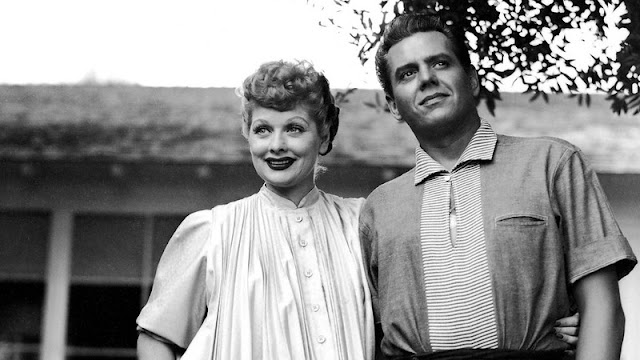
Sundance: Lucy and Desi


Lucille Ball and Desi Arnaz are having a moment. They were recently been the subject of Aaron Sorkin's new movie Becoming the Ricardos, which stars Nicole Kidman and Javier Bardem as the famous duo. And TCM's season three of their excellent podcast The Plot Thickens devotes an entire 10 episodes (plus a bonus one) to Lucille's story. Now there is a new documentary, directed by Amy Poehler and premiering on Amazon Prime March 4th, that takes viewers into the world of these two 20th Century icons. 

Lucy and Desi follows the story of the two entertainers from their early days in New York and Cuba, to their start in Hollywood, the success of the I Love Lucy show and Desilu Studios and beyond. The documentary includes archival footage, home video, family photographs, clips from I Love Lucy and audio recordings of Ball and Arnaz talking about their lives. Poehler wanted to tell the story of Lucy and Desi through their own words which she does effectively in this film. There are plenty of interviews too including with family members, experts, and celebrities like Carol Burnett, Bette Midler and Charo. 

The documentary demonstrates just how influential Lucy and Desi really were. A powerhouse couple in the entertainment industry, the resounding success of I Love Lucy and the birth of Desilu Studios revolutionized television production. Lucille Ball was a brilliant comedian and a free spirit. Desi Arnaz was a master at the business and a talented producer. The film also explores their marriage, including stories from their children, and even goes into some detail about their second marriages, which are often overlooked despite lasting longer than the Ball-Arnaz union. There is a really moving story, as told by their daughter, about Lucy and Desi's final meeting and their final phone call. 

There were a couple of claims made in the film which were a bit off. I'd have to revisit the doc to see what exactly was said because I only got one chance to see it. It was suggested that Lucille Ball and Vivian Vance were the first on screen female comedy duo. While that was a rarity, they were not the first and such a claim ignores the fact that comedic talents like Thelma Todd, ZaSu Pitts and Patsy Kelly (who all worked with each other in duos) existed before the advent of television. Also there was a claim that Lucy and Desi were the original lifestyle brand which also ignores how many famous actors were employed to market household products on radio shows and in magazine ads.

Lucy and Desi is a good primer for anyone wanting to learn about these two entertainment icons. However, I would steer people more towards TCM's podcast The Plot Thickens which is very well-researched, offers more information, includes plenty of audio so you get that feeling like you heard Lucille Ball tell her own story, but also has the added benefit of Ben Mankiewicz as host.


Lucy and Desi had its world premiere at the 2022 Sundance Film Festival and will be available on Amazon Prime in March.


Tuesday, January 25, 2022

Sundance: Living


It's been a long time since I've had a strong emotional reaction to a film like I had with this one. It really spoke to my soul in such a way that I was a wreck afterwards. It's brilliant, heartbreaking and soul-reviving. It breathed new life into me.

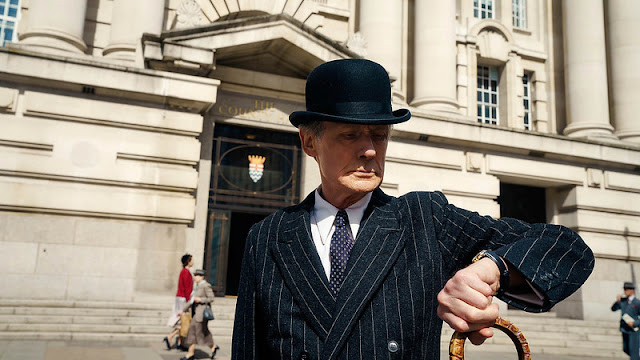
Written by acclaimed author Kazuo Ishiguro and directed by Oliver Hermanus, Living is a remake of Japanese director Akira Kurosawa's classic drama Ikiru (1952). Set in early 1950s London, the film stars Bill Nighy as Mr. Williams, a civil servant in charge of a government office that oversees projects. Mr. Williams is a widower living with his son Michael and daughter-in-law. Every day he takes the train into London to work and his routine is very set in stone. So much so that his coworkers know his routine and his quirks down pat and respect him enough to not to disturb his daily flow. His coworkers are a serious bunch with the exception of newcomer Peter Wakeling (Alex Sharp), who brings with him the enthusiasm of energy of a young man embarking on a new chapter, and Margaret Harris (Aimee Lou Wood), the sprightly young woman brings a bit of joy to the otherwise dullness of office work. Mr. Williams gets the devastating news that he has terminal cancer and little time left. He stops going to work, looking for a way to spend his final days actually living. After a few jaunts he realizes exactly what will give him a sense of purpose and a bit of happiness before his time runs out.

"I withdrew this cash and came down here to enjoy myself or live a little... but I realize I don't know how." — Mr. Williams

This film is breathtaking. Besides the poignant story, there are the wonderful performances, the stunning cinematography and the period authentic set design and costuming. Bill Nighy delivers an award worthy performance as Mr. Williams. He portrays his character as gentle, kind but ultimately lost. Mr. Williams reminds us that life is short and there is no time like the present to start living. At one point I felt the film would become too sappy, but the story steers us back to reality. We are human. We self-sabotage. We don't really grasp what living truly is. And we let a job eat away at our years, robbing us of a chance of really taking in the world around us. 

Living is a pretty faithful adaptation of Kurosawa's Ikiru in terms of story. The opening credits are laid over archival footage of 1950s London and for a moment it feels like we're watching the beginning of an old movie. 


Living recently had its world premiere at the 2022 Sundance Film Festival. I implore you all to see it when you can. It's really just a fine piece of filmmaking. It's a movie with a lot of heart. There isn't any information about future film festival spots or a public release but when there is I will add it here. In the meantime, if you haven't seen Kurosawa's Ikiru or want to revisit it, the film is currently available on the Criterion Channel.


Monday, January 17, 2022

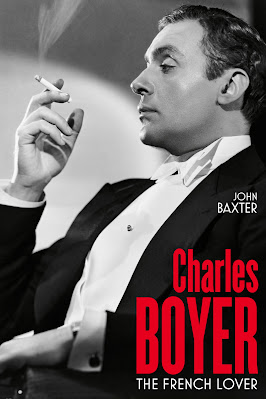
Charles Boyer: The French Lover by John Baxter

Charles Boyer
The French Lover
by John Baxter
Hardcover ISBN: 9780813155524
University Press of Kentucky 
298 pages
November 2021 

“For generations of film and theater audiences, Boyer was the archetypal Frenchman — cultivated, courteous, and seductive, yet never quite at home in a culture not his own. The sense of loss conveyed in his murmuring baritone voice was the very essence of romance. Women longed to comfort him; men wanted to become his friend.” — John Baxter

Charles Boyer charmed audiences for decades playing suave and debonair leading men in countless classic films. Audiences swooned at films like The Garden of Allah (1936), Algiers (1938), Love Affair (1939), Madame de... (1953). Boyer terrified us with his intensity in films like the psychological drama Gaslight (1944). His life began and ended with great tragedy but in the middle he found many ways to thrive doing what he loved best: acting.

Charles Boyer: The French Lover by John Baxter offers everything a reader would want out of movie star biography. It's compact, chronological, and concise. It's well-written and thoroughly researched. It offers just the right balance of personal and professional. It never crosses over to sensationalism yet delivers plenty of insights. The reader will come away feeling like they really got to know Charles Boyer as a person and as an actor and will immediately look for movies to watch to extend the experience. 

More books like this please!


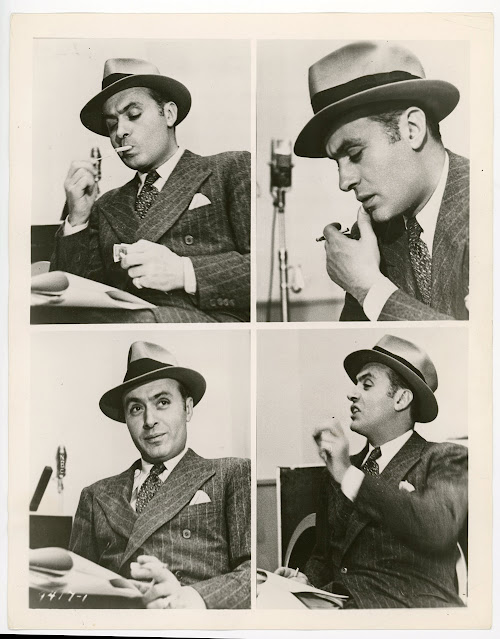
Boyer in 1939 rehearsing for his appearance on the
radio drama series Hollywood Playhouse.
Credit: NBC. Source: University Press of Kentucky


Some takeaways from the book:

  • Boyer came from a place of privilege and the author describes his journey to Hollywood as a progression rather than a struggle. 
  • Boyer loved reading and amassed a large collection of books (including over 3,000 first editions). He also had a penchant for gambling and smoking.
  • He was highly competitive and had a knack for memorizing dialogue. So much so that he would memorize all the parts of a script.
  • He was intensely private and turned down interviews whenever he could. Baxter writes “Boyer lived in relative simplicity, with only one other permanent staff member: his double and stand-in Irving “Fig” Newton, whom he kept on retainer. A part-time secretary handled business correspondence and fan mail—which, as an independent, Boyer had to respond to himself, rather than leaving it to a studio press office. He subscribed to no clippings service and did not employ a press agent. Requests for interviews were politely declined.”
  • Despite developing a reputation as "the French lover", Boyer was quite the misogynist and was open about his disdain for women. This changed when he met the love of his life Pat Paterson. Baxter writes “Marriage had softened Boyer’s hostility toward women. His new manner was gentler, amused, provocative.”
  • He started his career in Hollywood in bit parts or starring in the French productions of American films like The Trial of Mary Dugan and The Big House (my review of the three versions of that film can be found here)
  • Boyer insisted on leading roles because he valued his talent and knew that top billing meant top pay and top treatment. After WWII and with the rise of television, he began to take on more character roles in Europe.
  • Boyer's father died at a young age. He was met with tragedy later on in life when his son died by suicide and his beloved wife died of cancer. Boyer ended his life two days after Pat's death.


The author goes into detail about Boyer's working relationship with his leading ladies including Irene Dunne, Ingrid Bergman, Jean Arthur and Rita Hayworth. Mia Farrow, who grew up next door to the Boyers, was interviewed for the book and is quoted several times. Not every film is discussed the majority are. I found this a welcome relief as some biographies do try to tackle each and every film and if the subject's filmography is quite extensive this in turn can become quite exhausting. Some notable films discussed include: Red-Headed Woman (1932), Caravan (1934) Liliom (1934), The Garden of Allah (1936), Conquest (1937), Tovarich (1937), Algiers (1938), Love Affair (1939), All This, and Heaven Too (1940), Hold Back the Dawn (1941), The Constant Nymph (1943), Gaslight (1944), Cluny Brown (1944) and many more. There are some light spoilers but I didn't feel like it was necessary to be well-versed in Boyer's filmography to be able to enjoy the book. 

If you're a Charles Boyer fan or even mildly interested in him, don't miss out on this excellent biography.


A big thank you to University Press of Kentucky for sending me a copy of the book for review.

Thursday, January 6, 2022

Hollywood Victory by Christian Blauvelt

Hollywood Victory
The Movies, Stars, and Stories of World War II
by Christian Blauvelt
Foreword by Dr. Robert M. Citino
Hardcover ISBN: 978076249992
TCM and Running Press
240 pages
November 2021


“By the end of the war, motion pictures, having become the voice of the nation, would end up as the definitive American art form– America’s greatest cultural export to the world.” — Christian Blauvelt

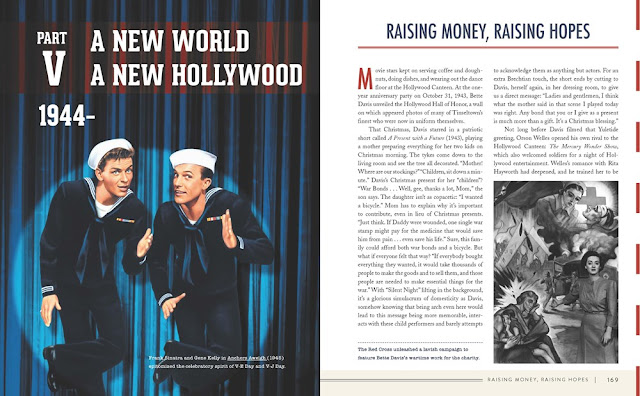
During WWII, movies reached the peak of their cultural influence over the American public. Hollywood rallied to support the war effort in many ways. Actors served overseas or entertained the troops. Directors documented battles on film to keep the American public back home apprised of what was happening during the war. Hollywood stars traveled all over the country selling war bonds. The Hollywood Canteen, started by John Garfield and Bette Davis, entertained the troops giving them a morale boost before they went off to battle. And it was movies like Confessions of a Nazi Spy that rang the alarm bells that something truly sinister was happening abroad. And when the United States officially entered the war after the attack on Pearl Harbor, movies offered the public a unique form of encouragement to help get through the struggles ahead.

Hollywood Victory: The Movies, Stars, and Stories of World War II by Christian Blauvelt takes a look at the many ways Hollywood participated in the war effort and bolstered the American public. This book featured themed essays that tackle many aspects of WWII Hollywood in a way that is both informative and visually appealing. It includes a wide breadth of stories; some classic film fans will be familiar with and others that will be quite enlightening. The behind-the-scenes or lesser known stories alongside the ones we come to expect to be told about the war enriches the reading experience.


Key figures discussed in the book include: Lena Horne, Betty Grable, Rita Hayworth, Jimmy Stewart
Henry Fonda, Clark Gable, Carole Lombard, Leslie Howard, Veronica Lake, Hedy Lamarr, Conrad Veidt, Peter Lorre, Otto Preminger, Anna May Wong, Orson Welles, Bob Hope, Carmen Miranda, John Huston, Hattie McDaniel, James Cagney, John Ford, Edward G. Robinson, Billy Wilder, Paul Robeson, Marlene Dietrich and many more.

“Entertainment is always a national asset… Invaluable in time of peace, it is indispensable in 
wartime.” — President Franklin Delano Roosevelt

Movies discussed at length include: Confessions of a Nazi Spy, The Great Director, Casablanca, Mrs. Miniver, The Human Comedy and many more.

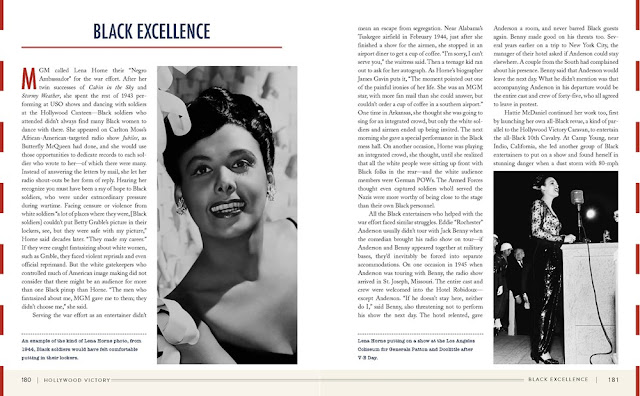
Much attention is given to the history of minorities during WWII. There are several essays about how Hollywood's involvement with Latin American talent as part of America's Good Neighbor Policy, how Chinese American actors were used to depict Japanese characters, how black soldiers were treated during the war and about black talent including Lena Horne and Hattie McDaniel who were very active on the homefront.

The essays are presented in a rough chronological order so you follow the story of Hollywood during WWII from right before Pearl Harbor to the end of the war in 1945.  I particularly enjoyed reading about how the studios approached telling war stories, about the Hollywood Canteen and the Hollywood Victory Caravan, how individual films made an impact on both audiences but also key power players and how each star approached their involvement in the war effort. I wasn't particularly interested in the pieces on Disney however animation enthusiasts will be eager to read more about that. 

Hollywood Victory is a must have for classic movie enthusiasts who have a particular interest in WWII history.

Thank you to TCM and Running Press for sending me a copy of Hollywood Victory for review. 

Check out the video below to see what else I've been reading.


Wednesday, December 29, 2021

Nightmare Alley (2021)


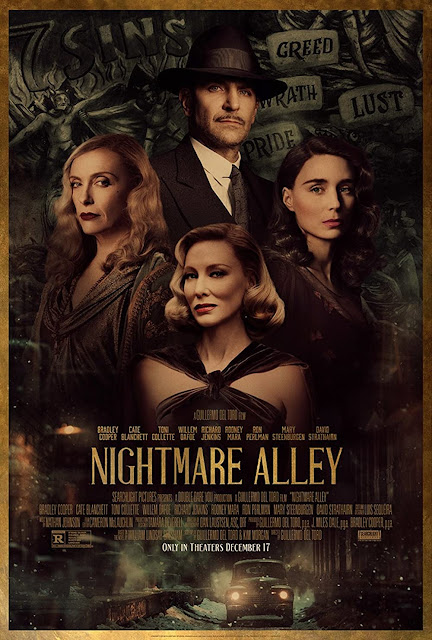
Adapted by Guillermo del Toro and Kim Morgan, Nightmare Alley (2021) is a magnificent adaptation that honors the film noir classic while giving contemporary audiences a grittier and more nuanced look at William Lindsay Gresham's story.

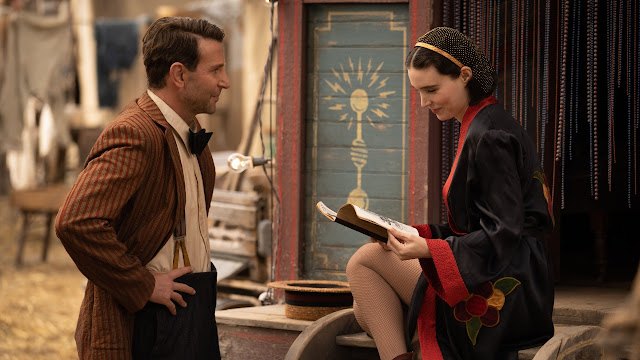
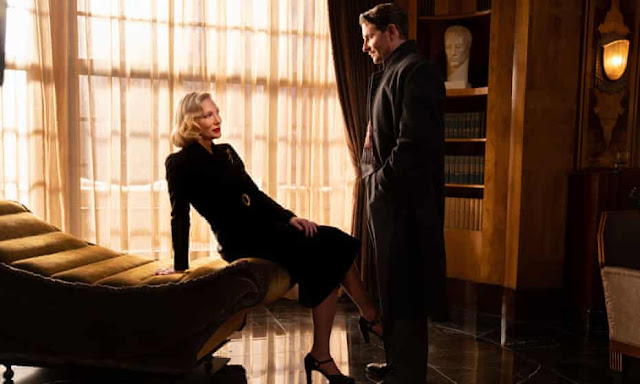
Stan (Bradley Cooper) has a dark past. One he leaves behind as he enters the carnival world. Intrigued and horrified by the resident geek, Stan catches a gruesome performance without paying the required fee. Carnival manager Clem (Willem Dafoe) catches him but takes pity on Stan and offers him an opportunity to work. Stan quickly becomes a beloved member of the group of carnies. Zeena the psychic (Toni Collette) and her partner and former mentalist Pete (David Strathairn) take him under their wings showing him the ropes. He soon masters the art of deception and showmanship. Stan falls for the young and naive Molly (Rooney Mara) who is under the watchful eye of strongman Bruno (Ron Perlman). After a tragic accident at the carnival, Stan and Molly run away to the city to put on a mentalist show for the wealthy elite at an elegant nightclub. They are thriving until Stan becomes a little too intoxicated with his own powers. He meets his match with Dr. Lilith Ritter (Cate Blanchett), a psychologist who knows the inner workings of many a wealthy patron at the club. The two join forces with tragic results.


I've struggled to appreciate the original adaptation of Nightmare Alley (1947), directed by Edmund Goulding and starring Tyrone Power, Joan Blondell, Coleen Gray and Helen Walker. I've watched it numerous times but have always been put off by how the characters prey on the vulnerable and how disjointed the film seemed. However, by watching this new adaptation and revisiting the old one now I have a new appreciation of how masterful the film noir adaptation truly was.

Here is a breakdown of who played which role in the two adaptations

Stanton "Stan"— Tyrone Power (1947) and Bradley Cooper (2021)
Zeena — Joan Blondell (1947) and Toni Collette (2021)
Molly — Coleen Gray (1947) and Rooney Mara (2021)
Lilith— Helen Walker (1947) and Cate Blanchett (2021)
Ezra Grindle— Taylor Holmes (1947) and Richard Jenkins (2021)
Bruno — Mike Mazurki (1947) and Ron Perlman (2021)
Pete — Ian Keith (1947) and David Strathairn (2021)
Clem Hoatley — James Flavin (1947) and Willem Dafoe (2021)

What makes the new adaptation different? We're given much more background on Stan. It's clear that he's a disturbed individual and Bradley Cooper does a great job conveying this (his final scene is mind blowingly good). In Tyrone Power's version, Stan is more of a charming opportunist. The events are a lot more gruesome and there is more at stake for this cast of characters. Toni Collette, Rooney Mara and Cate Blanchett all did fantastic job as the three main female characters. They have their own agency and don't necessarily exist to serve the main male protagonist. It's sad that it has to be said but there are many films where this is lacking. The new film expands the stories of some key characters including Clem, played by the always brilliant Willem Dafoe, as well as Ezra Grindle who is one of Stan's major victims. A lot of attention was put to visuals including costumes, decor and all the unique elements of the carnival, both big and small. There are some fantastic shots that are works of art in themselves. Dr. Lilith's office is an Art Deco dream. Anyone who loves the era will find a lot to enjoy from the beautiful to the macabre.

The 2021 version was written by Guillermo del Toro and Kim Morgan, who are both great appreciators of classic film (Kim runs the classic film and pop culture blog Sunset Gun!) and really dived into the sources material and into the life of the author William Lindsay Gresham whose own experiences influenced his writing. The new film is 2 hours and 30 minutes which ads about 40 minutes to the original. I highly recommend watching this in the theater to really immerse yourself in the visuals and the story because this is one you'll want to watch in one go.

Nightmare Alley is a fascinating study in human nature. What we're drawn to, what scares us, what drives us and how we manipulate others to get what we want. Both the film noir adaptation and the new version both drive home an awareness of the dangers of preying on others.


Nightmare Alley (2021) is currently in theaters and Nightmare Alley (1947) is streaming on the  Criterion Channel.

Popular Posts

 Twitter   Instagram   Facebook